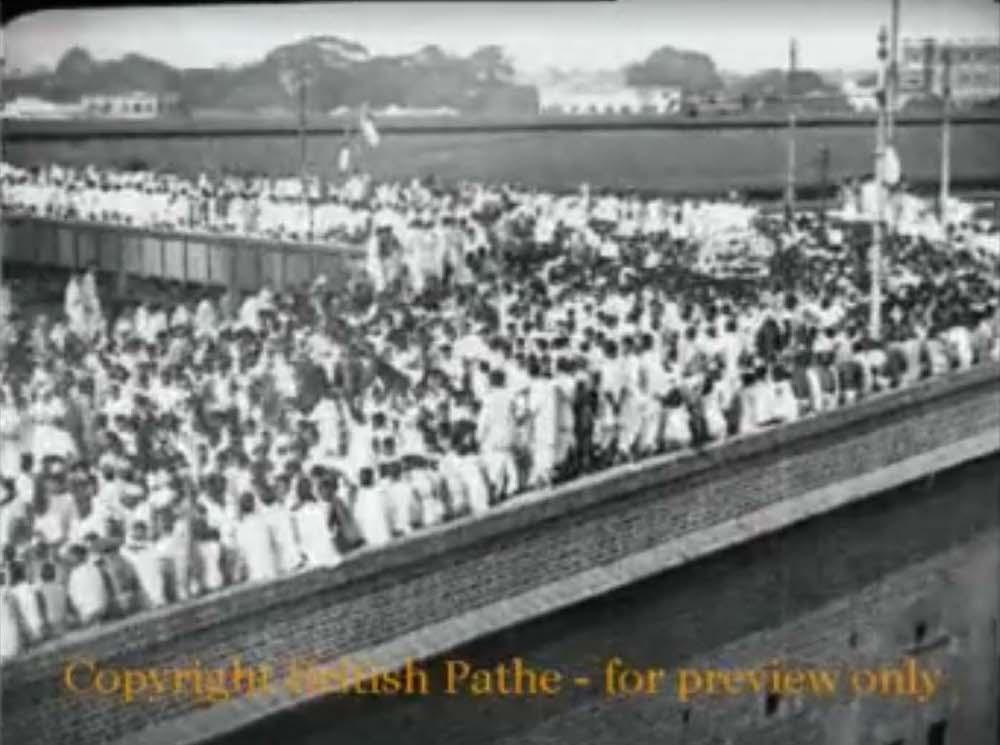
There is a photograph that should hang in every classroom in this country: the funeral procession of Jatindra Nath Dashttps://en.wikipedia.org/wiki/Jatindra_Nath_Das , 1929, winding through the streets of Calcutta. Six hundred thousand people walking behind the body of a twenty-four-year-old who had starved himself for sixty-three days in Lahore Central Jail. He was not demanding independence that day; he was demanding that an Indian prisoner be fed and treated like a European one. He died for the dignity of the jailed, and a nation that was not yet born carried him on its shoulders. Let me say that again: sixty-three days! That is two months of hunger strike and, of course, the beatings, the jail, the pain, the suffering.
Every generation gets to choose which side of the photograph it stands on. And every generation, without fail, produces men who would have called Jatin Das names while he starved and, probably, some of the very same men who would garland his portrait fifty years later.
This article is entirely my own. I only used AI tools for grammar and proofreading. Grammarly and Gemini estimate that about 5% of it is AI-generated.
Nations are real. That is precisely why protest matters.#
I have zero patience for the fashionable academic claim that the nation is merely a fiction. Benedict Anderson called nations “imagined communities”, and a generation of seminar rooms took that as a licence to sneer at borders, flags, and indulge in arm chair theorizing Aman ki Asha, and all the rest of it. But Anderson’s point cuts the other way: nations are imagined into existence and then become the most real thing in millions of lives.
Real enough that people willingly die for them. Real enough to cheer when eleven representatives of the nation lift a trophy; to cry when a moon lander misses its mark; or when the quiet prodigy from Chennai broke the Soviet-Russian monopoly to become the first Indian chess world champion. That is what a nation does.
Anyone who has lived across borders knows it in their bones: your passport is not a metaphor, and your zip code is a mortality table. Public-health research has shown the life-expectancy gaps between nations. Borders decide how long you live, and how you live.
So yes, the nation matters. External sovereignty matters and shatrubodh, the clear-eyed sense of who threatens you, matters. This is not jingoism. It is the adult recognition that the world is made of hard edges.
But here is the argument that the loudest patriots refuse to finish: if the nation is real, then what happens inside it is real too. If borders matter because they determine how citizens live, then the treatment of citizens within those borders is the entire point of having them. A border that protects a people who cannot speak is a prison wall. External sovereignty without internal sovereignty (the sovereignty of the citizen over her own voice, her own conscience) is an empty shell guarded at enormous expense.
Protest is not the opposite of nationalism. It is its proof.#
Bhagat Singh, who fasted alongside Das, wrote from his cell that the revolutionary needs two qualities above all: criticism and independent thinking. Not loyalty. Not deference. Criticism. He aimed it at the British, yes; but also at his own countrymen, his own party, his own comrades. That is the tradition. The tradition is not “my nation, right or wrong.” The tradition is “my nation, and therefore I will bleed to make it right.”
My school senior Richa Parasharhttps://www.instagram.com/richaparasher/ draws the essential line with lawyerly precision: “a nation is not a government.” The nation, in her telling, is the people themselves, bound together by culture, history, language, and a shared sense of who they are, something that existed before any government was formed, and that will and should outlast every government that follows. A government is a different thing: a system, a group of people temporarily entrusted with managing a state. Richa traces the sleight of hand by which we were made to forget the difference. She highlghts a three-step corruption of the vocabulary.
First, activist — a word that once simply described a person who cared enough to act — was slowly bent out of shape until it sounded like an get together of unemployable individual. Then anti-establishment, as though resisting power were itself the crime, as though the establishment and the nation were one and the same and the act warrants a chargesheet. And finally anti-national: the citizen who asks a question recast, just like that, as an enemy of the very country she belongs to.
I do believe there are anti-nationals who wound the very definition of the nationalism I set out above. But not every critic can be labelled anti-national.
So when a citizen today marches, refuses food, holds up a sign (and is then told they are anti-national) understand what is actually being said. They are being told that the nation belongs to the government of the day, and that criticizing the tenant is vandalism against the house. This is a lie, and a coward’s lie. Governments are weather; the nation is a climate. Article 19 of our constitution is not a gift the state gave the people. It is a receipt the people kept when they built the state.
The counterfeit and the currency#
But precisely because protest is sacred, its counterfeit is an insult to it and let no one pretend the counterfeit is not in circulation. The gold standard was set in Lahore Central Jail: sixty-three days of hunger with no camera crew, no rally schedule, no ticket to contest. Against that standard, look at what often marches under the banner today: professional agitators who materialize wherever the news cycle points, party flags folded discreetly in their pockets, outrage calibrated to the election calendar. A protest whose true demand is political momentum for its sponsors is not dissent; it is campaigning in borrowed clothes, and it cheapens the inheritance of every genuine dissenter who came before.
Worse is what some of these movements smuggle in under the slogan: the target quietly slides from a policy to a people, and critique of a government curdles into contempt for Hindus, or contempt for Brahmins as a caste, dressed up in the vocabulary of half-digested political-science seminars. An opposition that rides such theatre — led by a dynasty whose principal qualification remains the last name itself — should not be surprised when the public smells the difference between conviction and choreography.
And yet (and here the romantic must be ruthless with themselves) the counterfeit does not cancel the currency. That some protests are fake does not license the state to treat all protest as fake. Nor does the opposition’s cynicism discharge the government’s debt. If we demand sincerity from those who march, we must demand accountability twice over from those who govern because they hold the treasury, the police, and the law, and power owes answers in proportion to its weight. When will the government of the day stand in the road and answer its questioners, instead of counting the party flags in the crowd to decide whether the question is legitimate? The final test of a true patriot’s sincerity is severe: they must defend the opportunist’s right to march even while despising their opportunism because the day we let the state sort protests into real and fake, it will find, without exception, that every inconvenient one is fake.
Bear the ashes#
Justice D.Y. Chandrachud put it in phrase: dissent is the safety valve of democracy. Seal that valve and you do not get a stronger nation; you get a pressure vessel. Every regime in history that criminalized protest believed it was fortifying the nation, and every one of them was hollowing it out. A nation that cannot hear its own people has amputated its own nervous system, and a body that feels no pain does not become invincible.
So let them call you anti-national. Jatin Das wore that word for sixty-three days and what remained was carried through Calcutta by six hundred thousand mourners. Let someone smear the ashes of that accusation on your forehead. The romantic does not love the nation less for protesting ; the romantic is the only one whose love survives contact with the nation’s flaws. The pragmatists will manage the decline politely. The obedient will applaud it. But the ones who are romantic about this motherland will stand in the road and refuse to move, because that is what the fight for her actually looks like from the inside.
So I will say it one more time, because it is the only number in this essay that matters. Sixty-three days. Two months without food. The beatings from the jailer saheb. The cramped cell. A single quilt paying obeisance to the cold Lahore winter. A twenty-four-year-old who did not live to see the country he was starving for, and who was not even asking for that country; only that a man in chains be fed like a man.
And here we are. You are reading this on a lit screen, in a room you can leave, in a language you chose. You can put the essay down halfway and order a Swiggy burger or a Domino’s pizza. That is not the natural condition of human beings. That is a luxury. It was bought, in full, by people who did not get to enjoy a single day of it. Freedom is inherited wealth, and like all inherited wealth it is spent most carelessly by the generation that did not earn it. So argue! If you were taught to argue, you were taught by a tradition that argued with the Empire and paid for it in countless body bruises.
Do right, even when they curse you for it. Especially when they curse you for it. You owe it to Jatin Das. You owe it to this nation. You owe it for the comfort you did nothing to deserve.
That is the romance that moves movements forward.
Vande Mataram and Jai Hind!