“Before you start any work, ask yourself three questions :: Why am I doing it? What might the results be? And am I capable of succeeding at it? Only when you have thought deeply and found satisfactory answers, go ahead.” attributed to Chanakya, and quoted to me by Anup Mishrahttps://www.linkedin.com/in/anupm5999/
This piece is mine :: the notes, the confessions, the self-diagnosis. I used an LLM to fix my spelling and to help me turn a wall of run-on sentences into paragraphs a stranger could survive.
Ideally I should have asked the question in the title a long, long time ago. Around 2023, say, while I was still packing for a grand exit but here we are.
Here is the ledger, since a ledger is the honest way to open this. On one side: a paycheck with a comma in a pleasant place, an apartment in downtown Seattle and then in Burnaby, a porch, and a piano that arrived under the listing’s casual heading of well furnished and a nice red cherry Nissan Rogue in the parking spot. On the other side: a room in the inner wing of Mahanadi hostel, which on a bad afternoon does a convincing impression of the floor of a thermal power plant, and a Rockrider cycle.
I signed that deal voluntarily to come to the other side, and this is not a man laying out his sacrifices for somebody else to admire. Nobody made me do any of it. I traded the money for intellectual freedom because I wanted to, by my own volition, and I own the trade. Then I got into the PhD program, sat my comprehensive exam, performed badly, sat it again, performed badly again, and the question that should have been asked while the boxes were still open came and sat on my chest at 2 a.m.
Am I fit for a PhD?
Industry lets you reason lazily#
Amazon has a leadership principle called Dive Deep. I can recite it along with other LPs. I can also tell you that I mostly did not do it, and that the system around me was engineered so that not doing it was the correct professional choice.
A service is down. Is it mine? No? Then I do not need to know why. That is not negligence, that is the org chart working as designed. It is abstraction, computer science’s single greatest gift, aimed at people instead of at code. You are handed an interface, a runbook, an escalation path, and a firefighter access credential that expires in four hours; and the whole apparatus is tuned to convert a question into a ticket before the question can become a curiosity.
And where is the time? - Like, genuinely. There is on-call. There is the escalation. There is the postmortem for the escalation, and the action items from the postmortem, and the sprint that absorbs the action items. Depth is not forbidden in industry. It is simply never the thing on fire.
Which is not to say it never happens. When it does happen it goes further than any seminar room I have ever sat in. Put a price on a why and watch the company fund it without blinking. If your binary answers in eight milliseconds and the competitor’s answers in four, you will be handed a quarter and a mandate to go find them. And you will go down - through the code to the the exact electron responsible for flipping that one bit sitting exactly where the datasheet wants it.
That is Dive Deep in its fullest sense, and it is a beautiful thing to watch. But notice what licensed it. The question was never “why does this happen.” The question was “can we extract money from knowing why this happens”, and wherever the answer is no, the question gets closed before anybody thinks to ask it. Curiosity in industry is not banned. It is capitalised. And why not :: it is somebody else’s money. Nobody is paying you to feel intellectually alive at eleven in the morning ; they are paying you to do a job, and that arrangement is written down in the offer letter in a font everybody can read. I have no complaint against it, and anyone who takes the salary and then sneers at the terms is being professionally dishonest.
The complaint is against myself. The strange part is that back then, during my work in the industry, I was confident I would make a good PhD student. My reasoning was: I am curious about everything, and everything deterministic has an explanation waiting underneath it, and I am the sort of person who wants the explanation.
A detour through God, and arrogance#
I am a religious person, and I have never been able to make atheism sit still in my head as a purely scientific position.
Osho (Btw! he did his degree from Jabalpurhttps://en.wikipedia.org/wiki/Jabalpur , ) says -
“Belief is a barrier. Trust is a bridge.” Osho, From Death to Deathlessness, chapter 3, 4 August 1985
Everyone adores him for lines like that. Richard Dawkins puts the same instinct more arithmetically in conversationhttps://www.youtube.com/watch?v=U0Xn60Zw03A :: the probability of God is on the order of the probability of leprechauns or werewolves. Non-zero. Just very, very unlikely.
I have never been able to shake the feeling that a good part of atheism runs on something else. Not evidence (or the lack of it while bringing in belief), but posture: we don’t know yet, but we will know eventually; we always have. That sentence is doing enormous unpaid work. It promises a future receipt for a present certainty. It is, I think, a kind of arrogance ; the same arrogance that let me believe curiosity alone would carry me through a doctorate. I will understand everything. I will find the answer to everything. I only need to want it badly enough.
Comprehensive exam, attempt II, disagreed.
The roof of the hostel room#
I want to be careful here,I dont want a reader to read this like self-pity. It is not. This is the conclusion of several hours spent lying on a hostel bed staring at the ceiling, trying to hold two things apart that look identical from the inside: the sunk cost fallacy, and a legitimate early exit. Sunk cost tells you to stay because of what you have already burned; the early exit tells you to leave because the remaining road does not lead where you thought. They give opposite advice and at 2 a.m. the only way to tell them apart is to be brutally specific about what is actually broken.
So, specifically. I know a great many technologies. I know the whats, though superficially. Give me a system and I will tell you what it does, what it is called, what it competes with, and which conference talk to watch. Where I have hit a wall is the whys, and the wall is made of memory.
I forget. I forget constantly. I cannot hold last semester’s material without a lookup, let alone the computer science I read a decade ago. I cannot, sitting here, reconstruct from first principles on some of the whys that a PhD student must absolutely know. The mechanism underneath, the actual reason, has to be re-derived every single time, as though I had never learnt it.
A good response to this chronic forgetfullness was the most useful sentence: internalise the whys. The whys do not consume memory bandwidth. A what is a fact you have to store. A why is a generator that regenerates the facts on demand. I had spent a decade filling a cache and never once building the function.
Half a decade of easy lookup#
My hypothesis, and it is only a hypothesis, is that the lookup did this to me.
Want a query, Google it. Want a shell incantation, AskUbuntu-it. Want a snippet, Stack Overflow it. Want to know why a particular driver refuses to install, dig up some fossilised IRC archive from 2009 and read a stranger’s answer from a lifetime ago. Every one of these worked. Every one of these shipped. And every one of these quietly taught my brain that retention was somebody else’s responsibility, until the brain took the hint and became a volatile resource :: correct while powered, empty on reboot.
I was never a brilliant student anyway. My last great academic performance was in Class X, 17 years ago - my last big achievement will become an adult next year. Nothing in my academic record has ever screamed genius, and I have made my peace with the record. But I was curious, and I am curious, and I expect I will die curious.
Which brings the uncomfortable question :: is curiosity satiated by a PhD?
No. Honestly, no. Curiosity is satisfied by an afternoon and a good enough search engine. Nobody needs six years and a committee for curiosity.
So if the stated reason for coming here is not the real reason, the decision deserves to be re-audited from the top. Which is where Anup’s three questions come in.
Why am I doing it?#
I want to teach. That is the half of it.
Not “I want a faculty position”, though that is the shape it takes on paper. I want to be the person in the room who has patience, and who knows the whats, the whys, the hows, and the several different roads that arrive at each of them, because a student never comes at a concept from the road you planned for.
The other half is that I want the other thing academia has that industry structurally cannot give me :: the right to spend six months on something whose utility is laughable.
Here is the concrete daydream. I notice a Software Engineering problem. The clean fix is not a patch, it is a small language ; a DSL, a compiler pass, a language-level expression. In industry I know exactly what happens next, because I have watched it happen. A senior smiles at me, kindly, and says no. Not because the idea is wrong, but because the time investment is bizarre against the return, and they are right to say it. The economics does not checkout.
You can only build the beautiful (maybe useless) thing when that kind of money is not on the table.
Am I capable of what is required?#
Right now, every bone in my body says no.
I have some cold comfort available :: capability is usually a function of time, and with time everything changes. But I do not have age on my side the way my classmates do, and the honest reading of the evidence is that capability, past a point, is largely cemented - neuroplasticity or some cool biomechanical word which appears on these dopamine addiction videos.
The capability part has a resounding no in the present tense, and the entire bet of the next few years is whether a sufficiently strong why can drag a mediocre capable through the trials and tribulations of the whole journey.
That is the whole gamble, stated plainly. It is a worse gamble than the one I thought I was making in 2023, when I believed curiosity was a qualification.
I am taking it anyway.
Hopefully, same time next year, this page has some answers on it that I actually earned. And if it does not, at least it will have the ledger, honestly kept, and a record of a man who could still tell the difference between a sunk cost and a road that ran out.
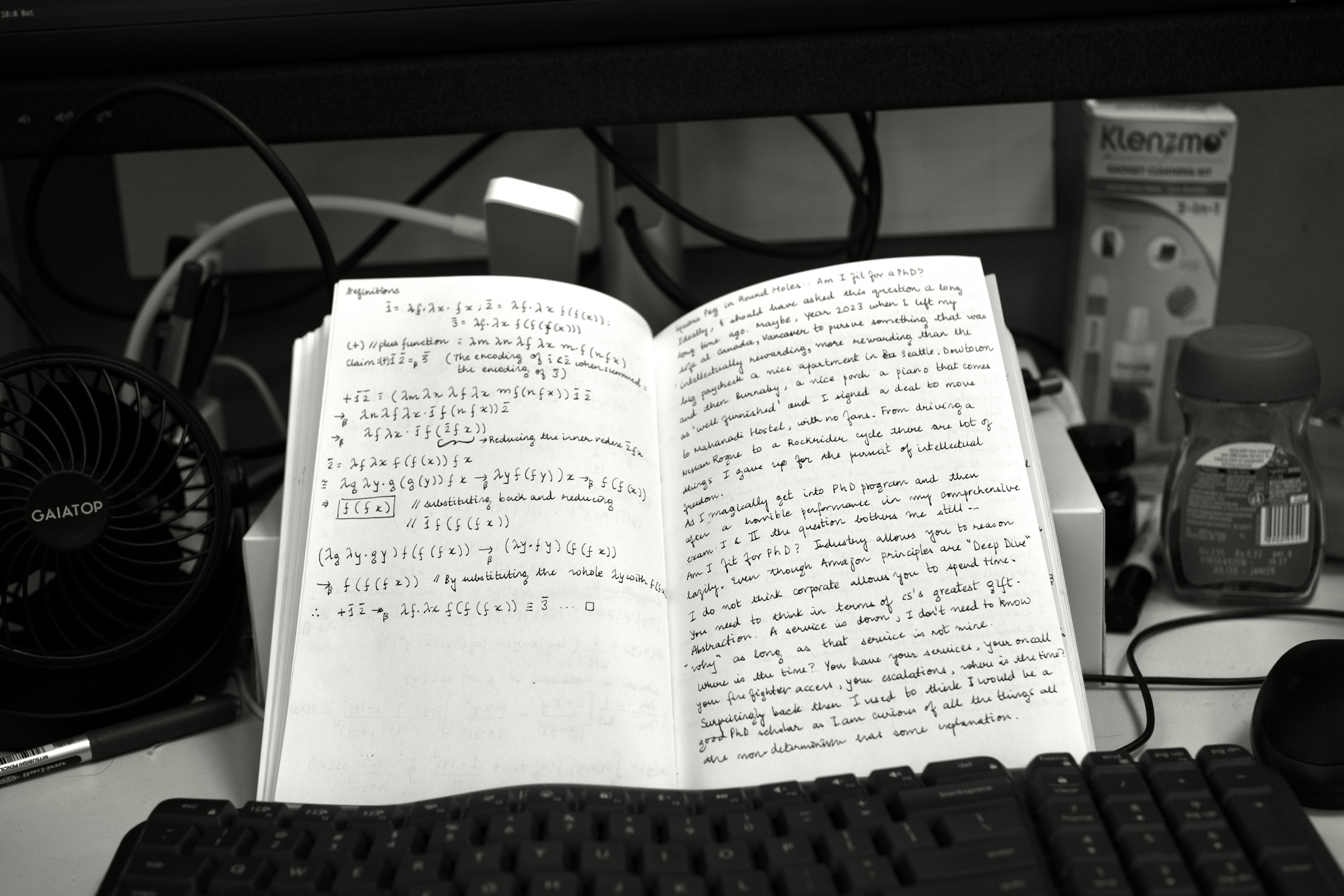
A note on the photograph#
I put that picture at the top for two reasons.
The first is the duality it caught by accident. On the left-hand page it takes β-reduction, to establish that 1 + 2 = 3. A four-year-old will hand you that fact for free. On the right-hand page, in the same ink, on the same evening, the same hand writes in plain English that it is not sure it belongs here.
That is the shape of this life, both halves of it visible at once. The enormous machinery required to make the obvious provable, sitting a spine-width away from the ordinary difficulty of making the personal sayable.
So if the temptation arises to file this under AI slop :: the notebook is right there in the photograph. :) :)