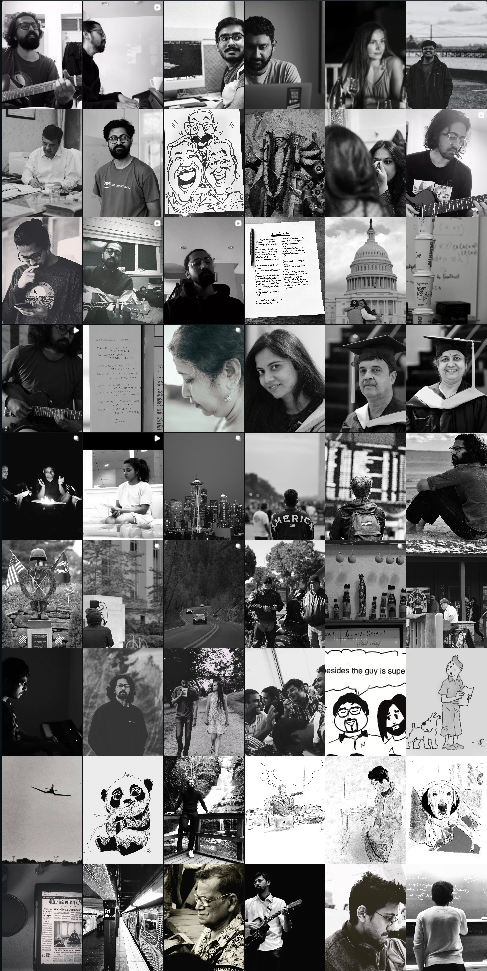
There’s a question I get asked often enough that I’ve started collecting answers for it: why do you shoot everything in black and white?
The honest answer is that I find something in a monochrome frame that color seems to smudge over. But “I just like it” is a terrible answer for anyone who actually wants to talk, so over time I’ve assembled a second, stranger justification; one that borrows from thermodynamics and from Shannon, and which I like precisely because it probably shouldn’t work.
Gibbs, briefly#
In chemistry, the Gibbs free energy equation tells you whether a reaction will spontaneously move forward:
$$ \Delta G = \Delta H - T \Delta S $$The short, lossy version is this; if you want the reaction to be favorable,
$$\Delta G$$has to be negative. And one of the easiest ways to get there is for the entropy of the system to increase, for $\Delta S$ to be positive. The universe, famously, prefers disorder.
That’s the direction of things. Forward. More states, more dispersal, more entropy. The arrow of time is, in a sense, the arrow of entropy pointing outward.
Shannon, briefly#
There’s a different entropy that lives in information theory. A fair coin can land in one of two states, so it carries one bit of information when it’s flipped. Two coins together can land in four combined states and carry two bits. Add a third and you’re at three bits, eight states. The more states a system can occupy; the more possibility, the more unpredictability; the higher its Shannon entropy. Information and uncertainty turn out to be the same currency.
This is where photographs come in.
A color photograph is a lot of information#
Consider what a color image carries. Every pixel is a vector; red, green, blue, each taking some value in some range; and the space of possible images is enormous. The information content is genuinely huge; the surface area of possibility vast.
Now strip the color out. What survives? Lines, contours, light and its absence, geometry. The shape of a face. The weight of a shadow. An expression. In a good photograph, nothing essential leaves when the color does - we still read grief, or tenderness, or the way the afternoon leans against a wall. What’s gone is the RGB vector space. The axes have collapsed. The entropy, in Shannon’s sense, has dropped.
You are conveying the same meaning with fewer possible states. That is, by almost any reasonable definition, a reduction in entropy.
The conceit#
Here is where I stretch the metaphor until it creaks, and I want to be honest that it creaks. The two entropies; thermodynamic and informational; are related but not interchangeable. You cannot literally reverse a chemical reaction by underexposing a roll of Tri-X. Boltzmann and Shannon are cousins, not the same person.
But imagine.
Imagine if every photograph taken in the world were a small monochrome act; a local subtraction of information, a pixel-by-pixel refusal of the RGB expansion. Imagine the universe, on aggregate, gently nudging its $\Delta S$ toward zero. The forward reaction; the relentless march of more, faster, brighter, louder; becomes, by the slimmest margin, unfavorable.
What then? We don’t go backward. Entropy doesn’t work like rewind. But perhaps we slow. Perhaps we stay. Perhaps the universe pauses, looks around, and decides it’s fine here, actually.
Or perhaps, for a moment, we tip into a state that feels older. Simpler. The way a black and white still of your grandmother in 1960 feels more like a memory than a document.
Why I actually shoot this way#
I know the physics is a conceit. I know the second law isn’t going to be repealed by my camera. But the metaphor tells a truth about why I shoot monochrome: because I want to make pictures that hold less and mean more. Because color is an engine of excess, and restraint is a kind of prayer. Because a frame that strips away the inessential is also a frame that says, this, this much, is enough.
Every photograph is a small argument about what to keep. Mine, it turns out, is an argument for keeping less.
And if, by some very slim thermodynamic accident, a million of us arguing the same thing were to hold the universe still for half a second longer I’d take that trade.